

Coffee cup
sizes.Espresso, cappuccino & latte
in oz and mL.
Coffee scenes are illustrative. For individual pieces, check the product’s stated capacity.
The best coffee cup size depends on the finished drink you make, including milk, foam, or added water. A small espresso cup needs much less room than a latte mug. Start with your usual serving, then choose a cup with enough space below the rim for comfortable pouring and drinking.
A cup can look generous in a photograph and still hold less coffee than you expect. Checking its capacity in US fluid ounces and milliliters makes the difference easier to understand before you buy.
Coffee Cup Sizes at a Glance
Use the table below as a starting point for choosing a cup. These are practical shopping suggestions, not fixed definitions of each drink. Recipes, serving sizes, and personal preferences vary.
| Your drink | Capacity · US fl oz | Approximate mL | Leave room for |
|---|---|---|---|
| Single espresso | 2–3 US fl oz | 60–90 mL | Space above the coffee and crema |
| Double espresso | 3–4 US fl oz | 90–120 mL | Your machine’s output and remaining room |
| Small flat white | 5–6 US fl oz | 150–180 mL | The combined coffee and milk volume |
| Cappuccino | 6–8 US fl oz | 180–240 mL | Room for your recipe’s milk and foam |
| Latte | 10–12 US fl oz | 300–355 mL | A larger milk portion and space below the rim |
| Filter coffee or Americano | 8–12 US fl oz | 240–355 mL | Your actual pour, plus any milk or water |
| Iced coffee | 12–16 US fl oz | 355–475 mL | Space taken up by ice as well as the drink |
Choose outside these ranges when your normal recipe needs it. A small latte and a large café latte will not fit the same cup simply because both are called “latte.”
For context, Loveramics' coffee cup collection includes an 80 mL espresso cup, a 150 mL flat white cup, 200 and 250 mL cappuccino cups, and a 300 mL latte cup. These are examples of how one manufacturer sizes its drinkware, rather than universal rules.
What Do oz and mL Mean on a Coffee Cup?
For drinking capacity, US fl oz means US fluid ounces, a measure of volume. It is different from ounces used to describe weight.
According to NIST's US customary-to-metric conversion table, one US fluid ounce is approximately 29.57 milliliters.
| US fluid ounces | Approximate milliliters |
|---|---|
| 3 US fl oz | 89 mL |
| 4 US fl oz | 118 mL |
| 6 US fl oz | 177 mL |
| 8 US fl oz | 237 mL |
| 10 US fl oz | 296 mL |
| 12 US fl oz | 355 mL |
| 16 US fl oz | 473 mL |
If a product is listed only in milliliters, divide that number by 29.57 to estimate its capacity in US fluid ounces. For example, a 140 mL cup holds approximately 4.7 US fl oz before allowing for any space below the rim.
What Size Cup Should You Use for Espresso?
A compact cup is a useful starting point for a short espresso. For a single serving, consider around 2–3 US fl oz; for a larger double serving, look at around 3–4 US fl oz and check your recipe.
The volume of the cup is not the same as the volume of the espresso.
A 3 US fl oz cup does not require a 3 US fl oz shot.
For one specific machine example, the Nespresso VertuoPlus manual lists factory beverage settings of 40 mL for espresso and 80 mL for double espresso. Those settings describe that system's output, not a rule for every espresso machine or recipe.
Leave room above the drink for crema and handling. If you add milk, choose by the finished drink rather than the espresso alone.
What Size Cup Works for a Cappuccino?
For a modest home cappuccino, a cup around 6–8 US fl oz is a reasonable size to consider. The right choice depends on how much espresso, milk, and foam you use.
Compare the cup's capacity with the whole recipe. A cup that easily holds your espresso can become too small once you add steamed milk and foam.
As a recipe-specific example, Nespresso's Momento Milk guide lists a 170 mL cappuccino. Your home recipe may be smaller or larger, so measure what you normally prepare rather than relying only on a drink name.
What Size Cup Should You Choose for a Latte?
A cup around 10–12 US fl oz is a useful starting point for a home latte with a generous milk portion. Choose a larger mug if your regular drink needs more room.
The same Momento guide lists a 260 mL latte macchiato and a 330 mL large latte macchiato. These examples show why milk-based drinks need attention to total volume. They do not define the size of every latte.
If you normally make a large milk-based coffee, a compact cup and saucer may suit a different drink or a smaller serving. Check capacity before choosing the color or glaze.
Cup Capacity vs. a Comfortable Fill
Before buying, check whether the stated capacity is measured to the brim or to a recommended fill level. Sellers do not always use the same convention.
A brim-full measurement tells you the maximum amount the vessel holds. It does not tell you how much coffee you can carry comfortably, or how much room remains for milk and foam.

For example, an 8 US fl oz serving takes up essentially all the space in a cup whose brim capacity is 8 US fl oz. A 10 US fl oz cup gives that same serving more room below the rim.
You can make the choice more concrete with a cup you already own:
- Fill it with cold water to the level you normally use for coffee.
- Pour the water into a measuring jug and note the volume.
- Compare that amount with the new cup's stated capacity and measurement method.
- Check the new cup's height, diameter, and overall width, including its handle.
This simple comparison helps you understand both the serving size and the physical scale of a new cup.
How to Choose a Ceramic Coffee Cup and Saucer
Once the capacity works for your drink, consider how the cup will fit into your day.
Check the handle. Look at the opening, position, and overall width. Product dimensions and several views are more useful than a single styled photograph.
Compare the cup and saucer together. A saucer provides a place to rest the cup and may accommodate a teaspoon, depending on its design. Check its diameter and what is included in the set.
Look at the interior as well as the exterior. Color, glaze, rim shape, and proportions all affect your impression of the piece. Clear product views should help you understand what you are choosing.
Read the care instructions. A ceramic body does not establish microwave or dishwasher suitability for the whole product. Wooden handles, decorative finishes, and other components may have their own requirements.
Coffee Cup Size FAQs
Is a standard coffee cup 6 or 8 ounces?
“Coffee cup” does not identify one universal capacity. It may refer to a small serving cup, a mug, or a coffee machine's own serving measure. Check the stated volume in US fl oz or mL rather than assuming every cup holds the same amount.
Is a 140 mL cup big enough for coffee?
A 140 mL cup is approximately 4.7 US fl oz. It can accommodate a short coffee if the complete serving fits below the rim. It is too small for an 8 US fl oz serving or a larger latte. Include any milk in your comparison.
Can I use the same cup for espresso and cappuccino?
Yes, if its capacity suits the finished drink. A cappuccino-sized cup can hold espresso, while a small espresso cup may not have enough room for your cappuccino's milk and foam.
Does a wider cup hold more than a taller cup?
Not necessarily. Height and width both contribute to capacity, and the wall thickness and interior shape also matter. Compare the listed volume rather than judging from the silhouette alone.
How much space should I leave below the rim?
Leave enough room to add your usual milk or foam and lift the cup comfortably. There is no single allowance that fits every cup shape and recipe. Check the seller's measurement method and compare it with your usual serving.
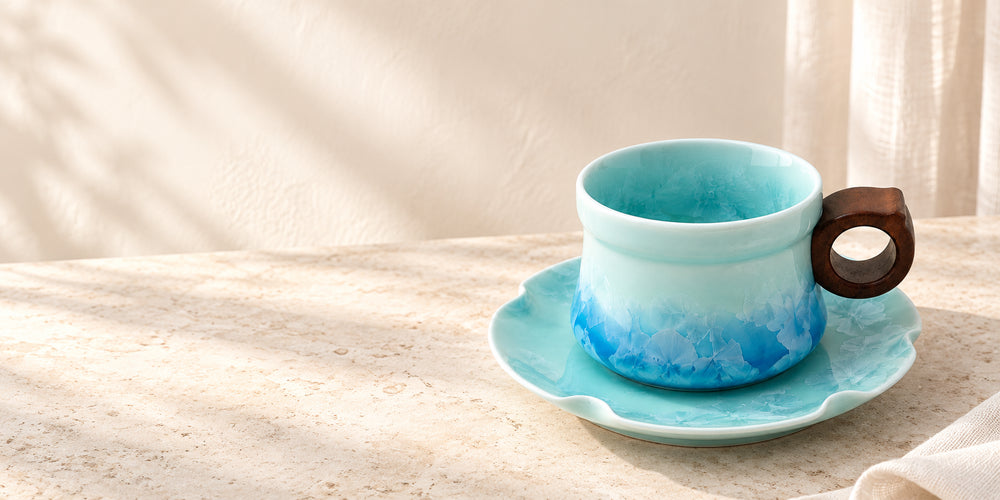
Your coffee.
Your cup.
Explore TailyMora’s ceramic coffee cups and saucer sets, then compare each piece’s capacity, dimensions, handle, and care information with the coffee you usually make.
Explore coffee cups ↗